Batting Cage Dimensions, Equipment, and Revenue: The Indoor Facility Owner's Guide
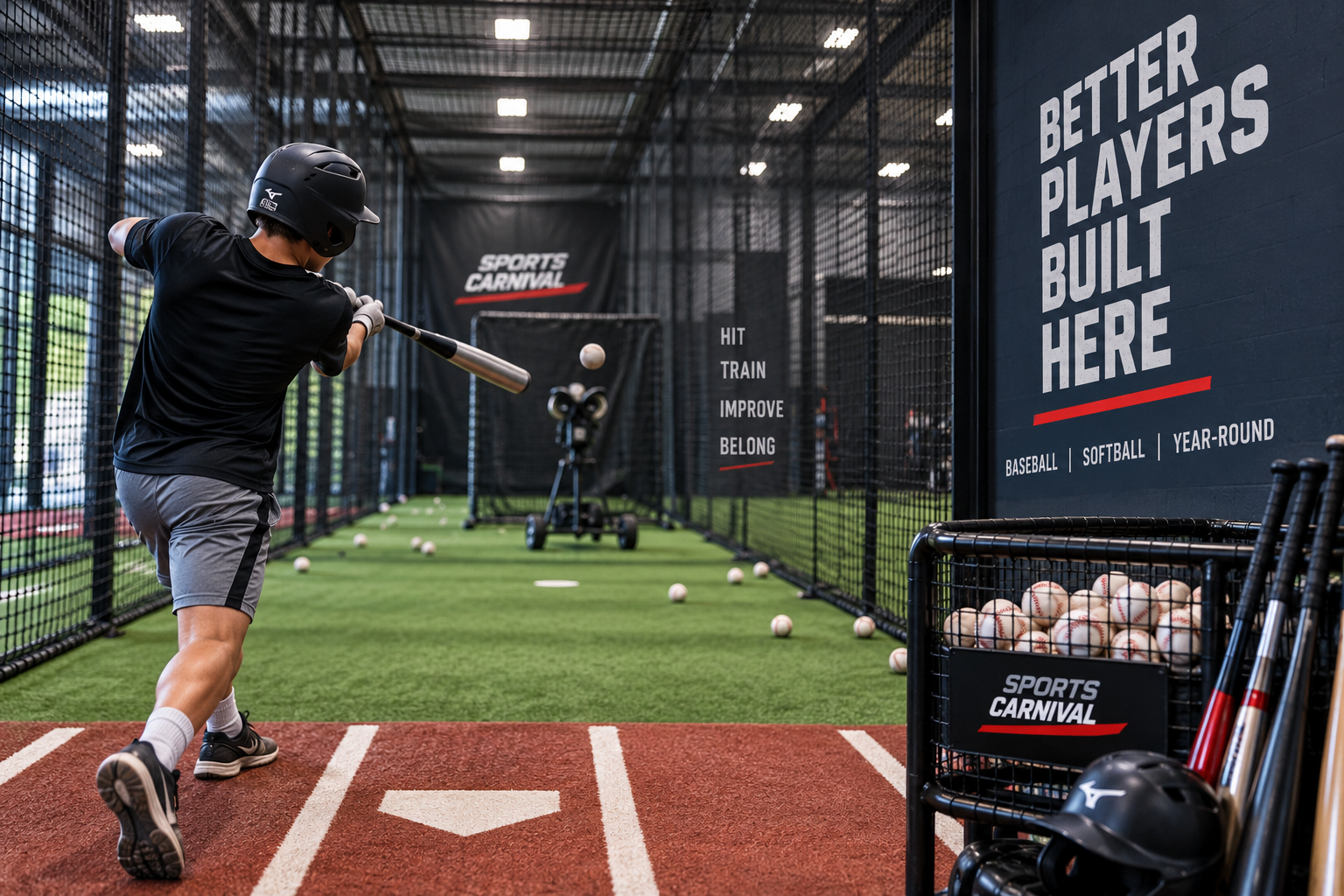
There's something about the crack of a bat, indoors, in February, with sleet coming down sideways outside, it sounds even better. Can you see that?
That's your whole business case, no matter where you live. Weather takes outdoor spaces offline for four to six months a year in most of the country and randomly in other parts. An indoor building doesn't care what's happening outside. A heated facility runs in January the same as it runs in July, which turns a seasonal sport into a year-round revenue line.
So the question was never whether to build. It's how to build one that fills.
Everything on this page covers the parts that are expensive to get wrong: cage dimensions, ceiling clearance, equipment specs, and the revenue models that separate an operation running at 40% utilization from one running at 80%.
Why Indoor Batting Cages Outperform Outdoor Space
Weather is the obvious answer. The less obvious ones are what actually sell memberships.
Balls stay contained. Netting on all sides keeps every ball inside the building during practice, so no foul balls into a parking lot, no chasing balls into a treeline, and no liability conversation about the neighbor's windshield. Containment is the safety argument for building indoors, and it is an insurance conversation in your favor.
Repetition goes up. Outdoor practice burns time on ball retrieval. Indoors, with a machine feeding and netting catching, a hitter takes swing after swing without stopping. Those reps are what build muscle memory, and high-volume reps are what serious players will pay for.
Conditions are controlled. No wind, no glare, no shifting light. When nothing outside the swing is changing, athletes can focus on mechanics and a coach can actually diagnose them. That's the difference between a place to hit and a real training venue, and it prices accordingly.
Batting Cage Dimensions: Getting the Space Right
Get the tape measure out before you sign a lease. Dimensions are the one thing you cannot fix later without tearing everything down.
Length by age group
A single tunnel runs 12 to 14 feet wide and 55 to 70 feet long.
Build to 70 feet. Every time.
Middle school and under: 55 feet is enough
High school and above: 70 feet, non-negotiable
Mixed-age training programs: 70 feet, because that's every venue
The retrofit cost when a 55-foot tunnel can't serve your best-paying customers will dwarf whatever you saved on square footage.
Ceiling height
Twelve feet is the floor, and it's a tight floor. Fourteen to sixteen feet is comfortable and lets a hitter finish a swing without thinking about it. If you run full infield practice, plan for 20 to 30 feet of clearance.
Clearance and buffers
Space around each bay matters more than owners expect:
Side clearance: 3 to 5 feet
Behind the machine: 5 to 10 feet
Behind the batter: 3 to 5 feet if families are watching nearby
Full infield practice: a dedicated 90 by 90 foot zone
Dividers between bays
Run net dividers rather than solid partitions. Coaches can see across the floor, parents can watch from one spot, and your front desk can supervise the room without walking it. Solid walls kill sightlines and force you to staff up.
Serving Baseball and Softball Players Under One Roof
This is the section most build guides skip, and it's the one that determines whether you can fill weekday evenings in spring.
Baseball and softball seasons overlap. If your venue only serves one, you're competing for half the market and going dark half the week. Serving both roughly doubles your addressable customer base for the same square footage.
The two need different setups, and the differences are cheaper to plan for than to retrofit.
Pitch distance and trajectory
Baseball training at the high school level and above works from 60 feet 6 inches. Fastpitch softball works from 43 feet, and youth divisions pull in closer. A 70-foot tunnel handles both, which is another argument for building long.
Trajectory is the bigger difference. A softball rises, drops, and arcs in ways a baseball doesn't. Softball players need machines that reproduce that movement, not just a baseball machine throwing a bigger ball.
Ball size and machine configuration
Softball is 12 inches. Baseball is 9. Your pitching machines need wheel settings for both, and your staff needs to know how to switch them without a service call. Buy machines that meet the spec for both up front. Retrofitting a baseball-only setup costs more than specifying it correctly.
Throwing and fielding work
Hitting is what sells, but throwing sessions and fielding drills fill hours that would otherwise sit empty. Dedicated pitching mounds let you sell throwing practice alongside cage time, and softball players training on windmill mechanics need that space just as much as baseball pitchers do.
Scheduling the overlap
Spring is when both sports peak at once. Teams want the same 5pm to 8pm block, and something has to give.
The operators who handle this well split their floor: baseball training on some bays, softball training on others, with a booking system that keeps team blocks and individual reps from colliding. Athletes from both move through the building on the same night without a scheduling argument at the front desk.
Gear Essentials: Pitching Machines, Netting, and Tech
This is where a venue either feels like the real thing or feels like a rented warehouse.
Pitching machines
Your machines need to handle baseball and softball across a usable speed range. Iron Mike models are a common choice, and most training sits in the 35 to 70 mph band. Higher-end pitching machines reach up to 90 mph for advanced hitters.
Buy programmable if you can. A machine that varies pitch type and speed lets you sell a different product: fastballs, then curveballs, at changing speeds. That isn't a rental anymore, it's a training session.
Netting and protection
Commercial-grade netting is not optional for daily heavy use. Consumer netting will fail, and it will fail during business hours.
Add heavy-duty vinyl backdrops in 22 oz. or 30 oz. weight with printed strike zones. They absorb the hardest contact and give pitchers a target.
Net sag matters more than people think:
Ideal sag: 12 to 18 inches
Too tight: balls ricochet back at the hitter
Too loose: sloppy rebound, faster wear
Technology add-ons
Tech is how you charge a premium for the same 30 minutes:
HitTrax or equivalent: live exit velocity, launch angle, and spray charts. Players will pay for the numbers, and parents will pay more.
Video capture: let athletes review their swing mechanics between rounds.
Screens: feedback displays in every bay, plus something on in the lobby.
Installation: Ceilings, Flooring, and Support Systems
Most setups hang from ceiling or wall-mounted cables. If you have the budget, go retractable.
Retractable batting cages buy you flexibility, and flexibility is revenue per square foot. When the netting pulls back, the floor becomes open space for clinics, off-season conditioning, and corporate events. A fixed setup earns money only when someone is hitting in it. Retractable batting cages earn money the rest of the time too.
Fair warning: retracting is a two-person job. Budget the labor into your open and close routine.
Flooring takes the real beating. Cleats, foul balls, and dropped bats will chew through an unprotected surface fast.
Artificial turf is the preferred surface inside the hitting zone, and not only because it wears well. It gives consistent footing for a hitter rotating through a swing, which is a stability and safety question before it's a durability one. A slick or uneven floor is how ankles roll. Use gym floor covers or carpet tiles for the surrounding areas, which is cheaper than refinishing and looks better on a tour.
Revenue Models: How These Facilities Actually Make Money
Rentals are the floor, not the ceiling. The operators who clear their numbers stack four or five revenue lines on the same square footage.
Hourly rentals
Pricing spreads wide depending on market and polish:
Public and municipal facilities: around $25 per half hour, $40 per hour
Typical independent facilities: $40 per hour, or $25 per half hour
Premium venues: up to $65 per hour per bay
Tokens and prepaid cards
Token machines are the highest-margin thing in the building. A session delivers around 20 pitches per token, and pricing lands near $2 per token in mid-size markets like Tulsa.
Prepaid cards move that revenue forward. A hitting club card at $100 for 2,000 pitches locks in cash today and buys loyalty for months. Punch cards do the same job: sell 10 or 20 sessions at a modest discount and you've banked the money up front.
Private lessons and personalized coaching
Two models, both viable:
Partner model: rent time to independent coaches at $15 to $25 per hour and let them run their own book
Direct model: employ your coaching staff, charge $60 to $100 per hour, keep the margin
Market rates for private lessons generally land between $50 and $85 per half hour depending on credentials. Personalized coaching is worth more than the rate suggests, because it fills weekday afternoons when your floor would otherwise be dark. It also builds the relationship that turns a one-time visitor into a member.
Group events and families
The highest margin per hour in the building:
Standard group packages: $200 to $500 for 10 to 15 people, 90 to 120 minutes
Birthday parties: add a host and a machine operator to justify premium pricing
Corporate outings: $400 to $800 for groups of 20 to 30
Families are the underrated segment here. Parents who bring one player for lessons will book the whole family to play on a Saturday if you give them a reason. Family rate cards and open-play hours convert a single customer into four.
Memberships and subscriptions
Here's the tension worth being honest about. A prime-time slot sold to walk-ins at $30 a session can generate $900 to $1,200 a month. That same slot committed to a member might return $150 to $200.
Walk-ins pay more per hour. Memberships pay every hour.
The resolution is to commit 15% to 25% of your hours to memberships, weighted toward off-peak, and leave prime time open for rentals and parties. You get a predictable revenue floor without giving away your best inventory.
Presell memberships during build-out. Money in the door before opening day is the cheapest capital you will ever raise.
Leagues, camps, and clinics
Predictable, seasonal, and community-building:
Adult rec leagues: $200 to $400 per team per season. A 12-team league is $2,400 to $4,800.
Youth camps and clinics: one-week training programs at $150 to $250 per child
Run three or four leagues concurrently and you're looking at $7,200 to $19,200 per season
Ancillary revenue
Small lines that add up. Many operators charge separately for helmet and bat rentals rather than bundling them. Add retail on grips, batting gloves, and drinks. None of it is glamorous, and all of it lands on the bottom line.
What Real Facilities Look Like
Useful benchmarks when you're sizing your build:
D-BAT Bothell runs 20 high-tech batting cages, an example of franchise scale
NC Baseball Academy operates 5 batting cages with 9 pitching machines, so multiple configurations per bay
North Seattle Batting Cages runs 5 batting cages plus dedicated pitching mounds
Five bays is a viable independent build that will meet demand in most mid-size markets. Twenty is a regional destination.
Also worth studying: market density. Seattle supports roughly 15 batting cages facilities, and Tulsa sustains several. These aren't winner-take-all markets. There's room for a well-run second and third operator, provided you differentiate on technology, coaching, or hours.
Staffing and Maintenance
You need fewer people than you think.
Front desk: one or two attendants during open hours at $14 to $18 per hour. They are the first impression and the upsell. Hire warm and capable over cheap.
Maintenance: someone mechanically inclined to service the machines. These run thousands of cycles a week and small problems become expensive ones fast. Equipment properly maintained lasts years longer.
Coaching: either contract with local instructors who bring their own athletes, or employ your own staff and keep the full lesson revenue. The partner model is lower risk and lower margin. Pick based on how much time you can otherwise fill.
Maintenance rhythm that keeps it all alive:
Weekly: tighten hardware, brush the turf, check every light
Monthly: deep clean surfaces, check torque on structural connections, test electrical
Annually: rotate nets to even out wear, deep clean and sanitize turf, run a full safety audit
Keeping the Operation Organized
You've built it, kitted it out, and staffed it. The thing that quietly eats margin next is admin.
Manual booking, disconnected payments, paper waivers, and missed upsells add up to real money. Not dramatically, and not all at once, which is exactly why owners don't catch it.
Sports Carnival is batting cage scheduling software built for facilities like these. It runs bookings, memberships, waivers, and payments from one place.
Real-time scheduling from one calendar, so double bookings stop happening
Integrated POS taking Apple Pay, Google Pay, and major cards through Stripe or Square
Dynamic pricing and upsells to raise average order value
Native digital waivers, membership management, and automated check-in
Lesson scheduling for coaching staff alongside open bay time
Recurring billing for memberships and package tracking for punch cards
Digital waivers mean first-timers sign at online checkout instead of at your front desk. Recurring billing means memberships bill themselves. Automated reminders cut no-shows, which is the cheapest revenue you will ever recover.
Pricing starts at $99 per month. The Growth plan at $199 per month removes per-booking percentage fees entirely, which is where most operators find the savings against percentage-based competitors.
Frequently Asked Questions
How long should a batting cage be? Seventy feet is the standard for high school players and above. Fifty-five feet is the minimum for middle school and younger. Build to 70 so you never have to retrofit.
What ceiling height is needed? Twelve feet is the absolute minimum. Fourteen to sixteen feet is comfortable for a full swing. Full infield practice needs 20 to 30 feet.
Can one venue serve baseball and softball? Yes, and it should. Baseball training runs from 60 feet 6 inches and fastpitch softball training from 43 feet, so a 70-foot tunnel handles both. Specify machines rated for both ball sizes up front.
How many bays should a new build be equipped with? Five is a viable independent operation and a common starting point. It supports lessons, walk-ins, and small groups at the same time without constant scheduling conflicts.
What does an indoor bay rent for? Roughly $40 per hour independently, up to $65 per hour at premium venues, with half-hour blocks around $25.
How do you fill weekday afternoons? Private lessons and memberships. Both are priced lower per hour than weekend walk-ins, and both convert hours that would otherwise earn nothing.
Putting It Together
Batting cages work because they convert a seasonal sport into a twelve-month business. That's the entire thesis.
The build is straightforward if you respect the specs. Go 70 feet. Get 14 feet of ceiling or better. Buy commercial netting and machines rated for baseball and softball. Use net dividers so one person can supervise the floor.
The business is straightforward too, but only if you stack the revenue. Rentals alone will not carry a venue. Tokens, private lessons, parties, memberships, leagues, and team practice together will, and they do it on the same square footage you already pay for.
Then keep the schedule full. That last part is an operations problem, not a construction problem, and it's the one most owners underestimate.
Ready to see how the scheduling side works? Take a look at Sports Carnival for batting cage facilities.
Continue Reading
Articles you might be interested in