How Much Does a Golf Simulator Cost in 2026?
If you are pricing one out, the honest answer to the question of how much does a golf simulator cost is that it depends on the kind of setup you want. A golf simulator built into a spare bedroom and a golf simulator built for a commercial venue are very different purchases, and the gap between them is wide. The same indoor golf simulator components can add up to a few thousand dollars or to six figures depending on the golf simulator setup you choose.
A home golf simulator might be a single bay used for practice on weeknights. A commercial golf simulator is a multi-bay setup built for paid bookings, memberships, and events. So before you compare any golf simulator cost numbers, decide which kind you are actually building, because that choice drives almost everything else about the price.
Across both, the appeal of an indoor golf simulator is the same. You practice or play year round, you get instant feedback on every swing, and none of it depends on the weather or finding a tee time. What changes is what is riding on the setup. At home, a weak golf simulator is a letdown. At a venue, a weak golf simulator is a room full of expensive gear that is not earning its keep.
This guide walks through golf simulator cost from both angles, breaks down what each component runs, and shows where the money actually goes once you move from a home golf simulator to a commercial one. A golf simulator is really a stack of parts working together, and the price of a golf simulator reflects the quality of that stack. A cheap golf simulator and a premium golf simulator can look similar from across the room but feel completely different to play. Whatever your budget, the goal is a golf simulator that plays like real golf, and that is what separates a serious golf simulator from a bargain-bin one. Spending more on a golf simulator is not always better, but spending too little on a golf simulator almost always shows.
What Is an Indoor Golf Simulator?
An indoor golf simulator is a setup that lets you hit real shots indoors and watch them play out on a screen, with no course or daylight required. The golf simulation technology reads your swing and the ball, then renders the shot in real time so you see carry, curve, and distance the moment you make contact.
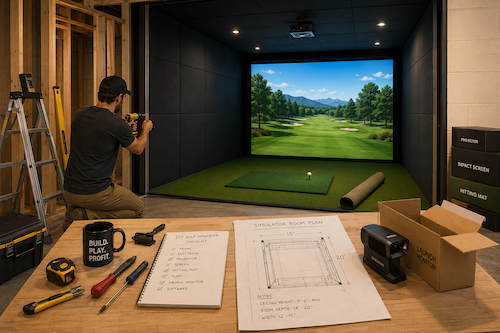
Most indoor golf simulator builds share the same core parts: a launch monitor, a hitting mat, an impact screen, a golf simulator projector, and the golf simulation software that ties everything together. In a home golf simulator, that combination is a practice space. In a commercial golf simulator, each bay is a small revenue center, and whether it makes money comes down to how often it is booked and how smoothly the venue runs.
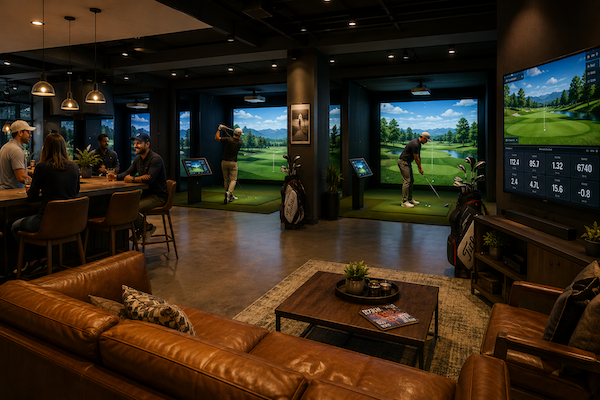
Indoor golf has grown fast over the past few years, and the indoor golf simulator has gone from a novelty to something people build entire businesses around. That growth is exactly why golf simulator cost has become such a common question, both for golfers planning a home golf simulator and for operators planning a commercial one. Whether it is a simple indoor golf simulator in a garage or a full commercial indoor golf simulator floor, the same basic golf simulator setup applies, and only the scale and the budget really change.
Home vs. Commercial: The Two Price Brackets
Before the component breakdown, here are the two brackets, because they sit far apart:
- A home golf simulator spans a huge range. The cost of a home golf simulator can range from under $2,500 for a simple build to over $70,000 for a premium room with tour-grade tracking. Most home setups land somewhere in the middle, often $5,000 to $20,000.
- A commercial golf simulator is priced per bay and starts around $10,000 to $25,000, then climbs with better equipment and build-out, because every bay has to survive constant daily use and still perform.
Keep those two lanes separate in your head as you read. A home golf simulator cost and a commercial golf simulator cost answer different questions, and mixing them is where most pricing confusion comes from.
Golf Simulator Cost Breakdown by Component
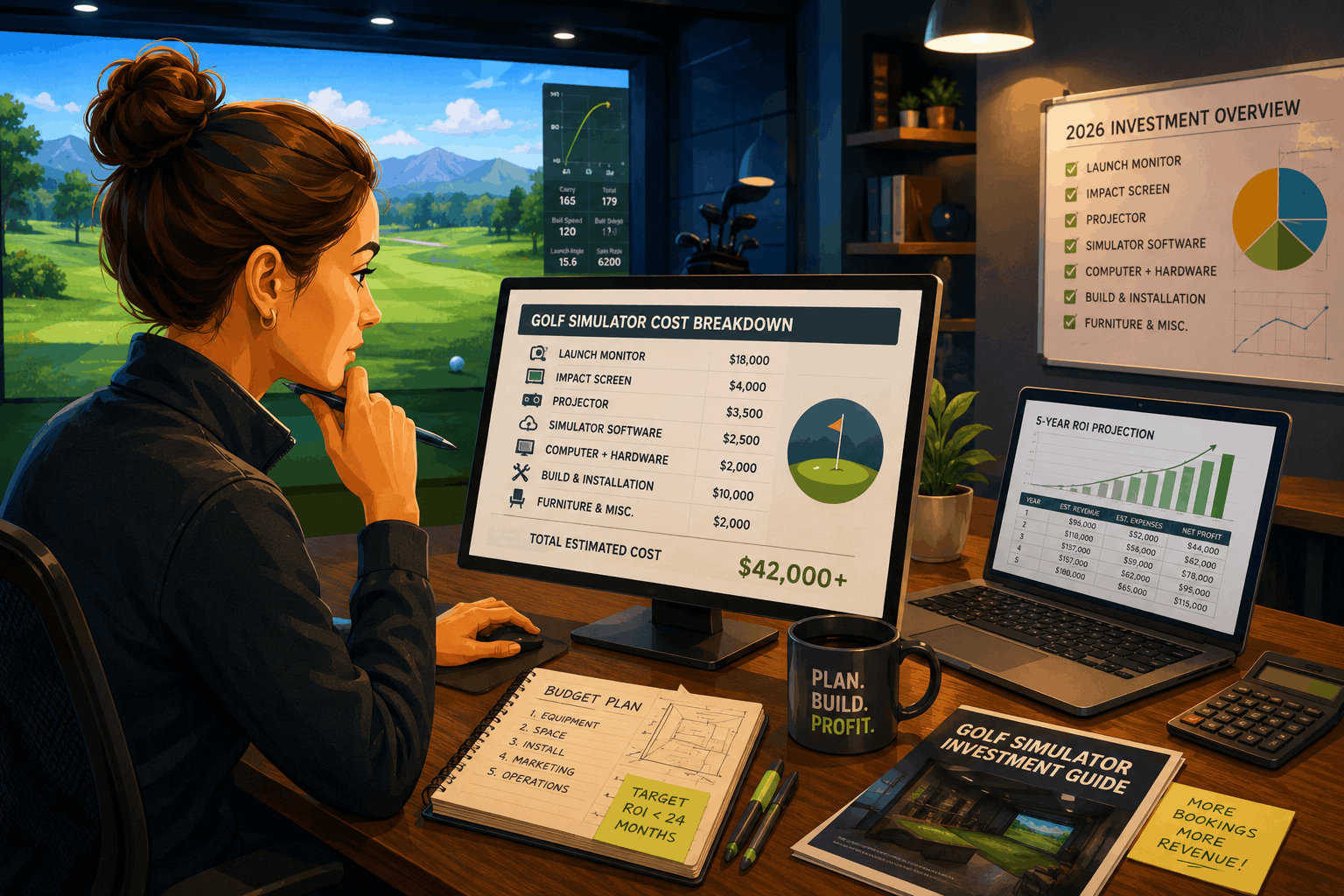
The cleanest way to understand golf simulator cost is to price the parts. Key cost drivers for golf simulators include the launch monitor, the enclosure, the screen, the golf simulator projector, and the computer system that runs the golf simulation software. Each one moves the total, and each one has a budget option and a premium option. Together these parts make up a complete golf simulator setup, and your golf simulator setup decisions are what set the final indoor golf simulator price.
Golf Launch Monitors
The launch monitor is the brain of any golf simulator, and it is the single biggest factor in how much does a golf simulator cost. A launch monitor reads what your golf club and the ball do at impact, then feeds that to the software. The data a good launch monitor captures includes ball speed, launch angle, spin, club path, and club head speed.
Ball speed tells you how hard you struck it. Launch angle tells you how high the ball started. Club path and the angle of the golf club face explain why the ball curved. Together, ball speed, launch angle, and club path turn a launch monitor from a number generator into a real practice tool, because the ball data actually explains your ball flight. The better the launch monitor, the more accurate the ball data, the launch angle, the club path, and the ball flight readings.
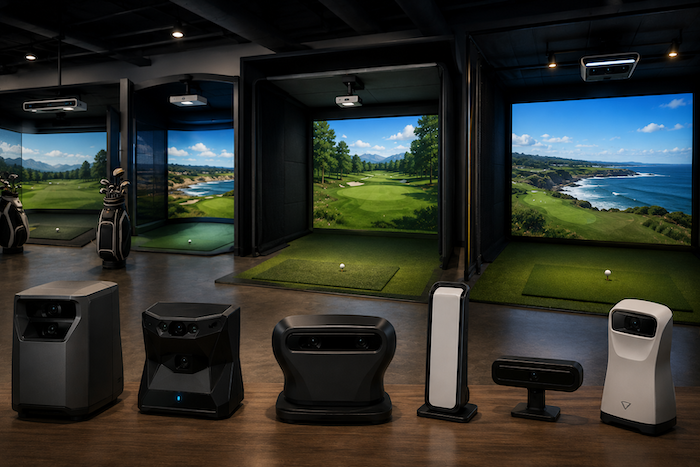
There are two broad ways a launch monitor reads the shot. Camera-based units watch the golf club and ball directly. Radar-based units track ball flight after impact. Either way, the quality of the launch monitor decides how true the ball flight feels.
Basic portable golf launch monitors start in the low hundreds of dollars and give you core ball data for a casual home golf simulator. Mid-range golf launch monitors run a few thousand and add club path, spin, and more reliable ball flight. Tour-grade golf launch monitors, the kind a commercial golf simulator or a high end golf simulator needs, run from roughly $10,000 to over $25,000 and capture the full ball flight, launch angle, club path, and club head speed with the accuracy serious players expect.
If you are deciding how much to spend on a golf simulator, the launch monitor is usually where you start, then you build the rest of the golf simulator setup around it. A high end golf simulator almost always starts with a high end launch monitor, because that is the component that decides how true the ball flight and ball data feel.
Golf Balls
Most golf simulators use real golf balls for accurate ball flight and ball data, though some players use limited-flight golf balls in tight spaces. Real golf balls give the launch monitor the truest read, so most setups stick with standard golf balls. You will go through golf balls over time, and a bucket of quality golf balls is a small line item next to the launch monitor. Foam or restricted golf balls are an option for a cramped home golf simulator where full-speed golf balls feel risky, but for the most accurate ball data, real golf balls win.
Golf Simulator Projector
A golf simulator projector is what puts a big, sharp image on the screen. A short-throw golf simulator projector is the usual choice because it sits close to the screen, throws a large clear picture, and keeps shadows out of the way. A golf simulator projector typically runs from a few hundred dollars to a couple thousand, depending on brightness and resolution. You want it bright enough that the room does not feel dim and matched to your screen's aspect ratio so the picture fits the impact screen properly.
Impact Screen and Enclosure
The impact screen is one of the hardest-working parts of any golf simulator. The impact screen takes every shot, so a durable impact screen is not optional, it is the difference between a screen that lasts and one that frays in a season. The impact screen also keeps stray shots from tearing up the room, which is why a durable impact screen matters even more in a busy commercial golf simulator.
Enclosure and impact screens can cost from $290 to over $5,000. A basic impact screen on the low end works for a light-use home golf simulator. A premium, durable impact screen on the high end is built for a commercial golf simulator that runs all day. The impact screen quality you choose affects how the golf simulator looks and how long the impact screen survives.
A full enclosure wraps the impact screen in padded sides so errant shots stay contained. Most golf simulator packages pair the impact screen with an enclosure for exactly this reason, so when you price an impact screen, factor in the enclosure too. A cheap impact screen with no enclosure is how rooms get damaged, while a durable impact screen inside a solid enclosure is how a golf simulator survives heavy use.
Hitting Mat and Net
The hitting mat is the surface you stand on and swing from, so a good hitting mat matters more than people expect. A quality hitting mat is more comfortable and far easier on your wrists and elbows than a cheap golf mat. A bad golf mat can cause pain over time, while a good golf hitting mat absorbs impact and protects your joints.
A basic golf mat runs around $100. A premium hitting mat or commercial golf hitting mat with realistic turf runs well over $1,000. For a home golf simulator, a mid-range hitting mat is plenty. For a commercial golf simulator, you want a durable golf hitting mat that holds up to constant use, because a worn golf mat gets replaced fast.
If you want extra safety, a net helps catch a shanked shot. But the hitting mat is the part you touch every swing, so do not pair a great launch monitor with a bargain golf mat. A good hitting mat is cheap insurance for both your body and your golf simulator.
Golf Simulation Software
The golf simulation software is what puts virtual courses on the screen and turns a launch monitor's data into a game. Good golf simulation software, sometimes called golf simulator software, runs roughly $250 to $1,000, either yearly or as a one-time cost, and some launch monitors lock their full course libraries behind a subscription on top of that.
The best simulation software ships with a deep library of virtual courses. You can play a famous virtual course like Pebble Beach, set up a casual golf game with friends, or grind range sessions for game improvement. A strong virtual course library is a big part of why many golfers buy a simulator in the first place, since it turns practice into endless entertainment. For an avid golfer, the virtual golf experience and the game improvement tools are the whole point, while for many golfers it is simply the immersive experience of playing a virtual course indoors.
This is also where golf simulator software and golf simulator brands differ. Different golf simulator brands lock different virtual courses behind their own software, so the right golf simulator for you may come down to which virtual courses and which golf simulation software you want. Whether you are building your own golf simulator for game improvement or for endless entertainment, the simulation software shapes the experience as much as the hardware. For game improvement, the software's practice tools matter; for endless entertainment, the virtual course library matters. The immersive indoor golf experience comes from the software just as much as the screen, and that immersive experience is why golf simulator software is worth comparing as carefully as the hardware. A high end golf simulator pairs great hardware with great golf simulation software for the most immersive experience and the most realistic virtual golf experience, the kind of immersive indoor golf experience that keeps people coming back for endless entertainment.
One thing that trips people up: golf simulation software and booking software are two different things. The first is the game that runs the golf simulator. The second is how a venue actually runs its business. If you are operating bays for revenue, that second piece is where a golf simulator booking platform like SportsCarnival comes in, handling bookings, payments, memberships, and scheduling across every bay.
The Computer System
Every golf simulator needs a computer to run the golf simulation software and talk to the launch monitor. A capable PC for a home golf simulator runs $1,000 to $2,500. Skimp here and you will watch your shots stutter across the screen, so the computer system belongs on the cost list alongside the launch monitor and screen. When people ask how much does a golf simulator cost, the launch monitor is the answer that moves the number most, so how much does a golf simulator cost really depends on which launch monitor you buy.
Golf Simulator Package vs. Building Your Own
You can buy a golf simulator package that bundles the launch monitor, screen, mat, projector, and software together, or you can assemble the parts yourself. A golf simulator package is simpler and often a little cheaper than buying piece by piece, while a custom golf simulator setup gives you more control over each component. For a home golf simulator, a package is usually the easier path. For a commercial golf simulator, most operators end up customizing for durability and throughput. Across every build, the launch monitor and the impact screen are the two parts that most affect both price and play, so put your money into the launch monitor and a durable impact screen before you spend anywhere else.
Golf Simulator Cost for Commercial Venues
A commercial golf simulator is not just an equipment purchase. The whole thing is built around bays that need to stay booked, customers moving through, and an operation that does not fall apart on a busy Saturday. The money follows utilization. A bay that sits empty half the day is the fastest way to sink the math on a commercial golf simulator.
Indoor golf has become one of the fastest-growing corners of sports entertainment, and an indoor golf venue lives or dies on utilization. The indoor golf customer expects a high end golf simulator with a tour-grade launch monitor, so most indoor golf operators invest in a high end golf simulator and a premium launch monitor rather than cut corners. That is the indoor golf reality: the better the launch monitor and the more polished the indoor golf experience, the more an indoor golf venue can charge per hour.
Here is what you are actually paying for at a venue, on top of the equipment above:
- The bays themselves. Most venues run between 2 and 10 bays. More bays means more revenue, but also more to manage and more square footage to plan around.
- Staff. Someone handles check-ins, helps customers, deals with the tech when it acts up, and runs coaching if you offer it. Staffing affects both the experience and how many hours each bay is actually open.
- Booking and management software. This keeps bookings, payments, memberships, waivers, and scheduling straight across every bay. Skip it and you get double-bookings and dead time. SportsCarnival pulls all of that into one place.
- Insurance and compliance. Liability coverage and equipment protection are an ongoing line item, not a one-time cost.
- Maintenance. Heavy use wears down mats, screens, and turf, and the tech needs occasional recalibration to stay accurate.
The result is that a commercial golf simulator cost runs well past the equipment sticker. Here is the rough per-bay picture:
| Setup Type | Estimated Cost | Best For |
|---|---|---|
| Entry-Level Commercial | $10,000–$25,000 per bay | Small venues, startups, pilot spaces |
| Standard Multi-Bay | $25,000–$50,000 per bay | Established businesses, entertainment venues |
| Premium / High-Performance | $50,000–$100,000+ per bay | High-traffic venues, franchises, premium centers |
Home Golf Simulator Cost
A home golf simulator is the more common starting point, and its cost is all over the map. If you are wondering how much does a golf simulator cost for a home setup, the honest indoor golf simulator answer is that it is a range, not a single number. As noted above, the cost of a home golf simulator can range from under $2,500 to over $70,000. High-end golf simulators can exceed $70,000 when you combine a tour-grade launch monitor with a premium screen, a custom enclosure, and a dedicated room.
For most people, a solid home golf simulator lands between $5,000 and $20,000. That budget gets you a reliable launch monitor, a decent impact screen and enclosure, a good golf simulator projector, a quality mat, and golf simulation software with a real course library. Spend less and you trade away accuracy and durability. Spend more and you are paying for tour-level data and a more immersive room.
The point of laying out the home golf simulator cost this way is simple: the number depends entirely on the components you pick. There is no single price for a home golf simulator, only a range, and where you land inside it is a series of choices.
Common Mistakes That Inflate Golf Simulator Cost
A few avoidable mistakes quietly drive golf simulator cost up or leave you with a setup that does not work the way you hoped.
Not checking the dimensions first. Measure ceiling height, depth, and width before you buy anything. Knowing how much space you have comes first, because how much space you have decides what you can build. You need room for a full swing without clipping anything. A tight space limits your equipment options and, in a commercial golf simulator, slows down how many people you can move through a bay.
Buying the wrong launch monitor. Some golf launch monitors are fine for casual ball data and some are built for heavy commercial use and detailed swing analysis. Get this wrong and you are either overpaying or stuck with something that cannot keep up. Brands vary a lot on price and support, so it pays to research before you commit.
Cheaping out on the mat or screen. Low-end mats and impact screens cost less now and wear out fast under real use. For a commercial golf simulator that means replacements, downtime, and a worse experience for paying customers.
Forgetting installation. People budget for the gear and forget the electrical work, the build-out, mounting, flooring, and actually installing the golf simulator. Those costs add up and change your real total, especially on a multi-bay commercial golf simulator.
So What Should You Spend on a Golf Simulator?
It comes down to what you want out of it. The question of how much does a golf simulator cost never lands on one number, because every golf simulator setup is a different mix of parts, and a bundled golf simulator package will price differently than a custom build. For most home buyers, the value is the virtual golf experience and the immersive experience of playing great courses without leaving home. Some people want a casual home golf simulator to mess around on after work. Others want precise data to actually get better and will pay for a tour-grade setup. Operators are running a business, where the golf simulator is only part of the picture and utilization is the real number that matters.
If you are building a commercial golf simulator, the gear is the easy part. Keeping the bays booked and the operation running is the hard part, and it is where the money gets made or lost. A profitable golf simulator is a well-run golf simulator, not just an expensive one. SportsCarnival handles the bookings, memberships, payments, and scheduling so you are not running the whole venue off a spreadsheet.
If the business side is what you are really weighing, our guide on how to start a golf simulator business goes deeper on the operator math behind a commercial golf simulator.
FAQs
How much does a golf simulator cost? It depends on home or commercial. A home golf simulator can range from under $2,500 for a basic build to over $70,000 for a premium room, with most landing between $5,000 and $20,000. A commercial golf simulator runs higher, roughly $10,000 to $25,000 and up per bay, since it is built to take constant use.
What are the main golf simulator cost drivers? Key cost drivers for golf simulators include the launch monitor, the enclosure, the impact screen, the golf simulator projector, and the computer system. The launch monitor is usually the biggest single line item, with tour-grade golf launch monitors running $10,000 and up.
How much space do I need for a home golf simulator? Plan on about 9-foot ceilings, enough depth for a full swing, and around 10 feet of width. Measure for the swing, not just standing height. If your driver hits the ceiling, the room is too small for a home golf simulator.
Are golf simulators realistic? Modern golf simulators have gotten very good. A solid launch monitor tracks your ball and club accurately enough that the golf simulation feels close to the real thing, and high-end golf simulators are convincing enough for serious practice.
What does it cost to run a golf simulator business? A commercial golf simulator costs more than the equipment alone. It varies with how many bays you have, plus staffing, insurance, software, and facility costs, and premium bays climb once you factor in build-out and installation. Our golf simulator business guide breaks it down.
Continue Reading
Articles you might be interested in