How to Start a Profitable Golf Simulator Business
Indoor golf went from a niche idea to one of the most interesting opportunities in entertainment, and the money behind it is hard to ignore. The catch is simple: a golf simulator business only pays off when you run it well. Buy a few bays and hope, and you have an expensive room. Plan it properly, and you have a venue people book again and again.
This guide covers what it actually takes to start a golf simulator business: startup costs, the simulator technology that matters, your revenue streams, a pricing strategy that holds up, and the business plan that ties it together. Whether you are a first-time business owner or adding a location to an existing commercial business, the fundamentals do not change.
What Is a Golf Simulator Business?
A golf simulator business is an indoor golf facility where people play and practice on a screen, with no tee time or daylight required. Launch monitors read the ball and club, software renders the shot, and players get a round without driving out to one of the local golf courses.
For a lot of customers, that convenience beats traditional golf. They get the feel of actual golf, accurate ball data on every swing, and a comfortable room instead of a five-hour round in the heat. The software loads dozens of real golf courses, so a member can play different golf courses every week without leaving your venue. That gap between easy indoor golf and a real commitment to green-grass golf is the whole reason the indoor golf business exists. Some people call it an indoor golf simulator business and some call it a sim lounge, but every indoor golf simulator business runs on the same truth: keep the bays full and the experience sharp. Run your indoor golf simulator business that way and it lasts.
The Golf Simulator Industry Is Growing Fast
Before you spend a dollar, get a feel for the market dynamics, because they are unusually friendly at the moment.
The golf simulator industry is expanding on every estimate. Grand View Research puts the global golf simulator market at $2.12 billion in 2025, growing to $4.12 billion by 2033. Fortune Business Insights pegs it near $1.92 billion in 2025, climbing to roughly $4.7 billion by 2034. Some projections move faster still, with one forecast expecting the global golf simulator market to reach $3.3 billion by 2027. The exact number depends on who is counting, but the drivers are consistent: year-round play, rapid technological advancements in tracking and software, and a steady shift toward indoor formats.
Participation backs it up. The National Golf Foundation reported a record 48.1 million golfers in 2025, and 19 million of them played only off-course, at driving ranges, indoor golf venues, and entertainment venues like Topgolf. Off-course golf is where the growth is, and an indoor golf facility sits right in the middle of it. If you have been thinking about how to start a golf simulator business, this is a rare window where demand is growing faster than the supply of good venues.
Different Types of Indoor Golf Businesses
Not every indoor golf business looks the same. The model you pick shapes your space, your pricing strategy, and the customer segments you chase. Your target audience drives the choice: a training-focused target audience wants very different things than a night-out target audience, and the business model follows from that. Indoor golf venues that pick one lane and commit tend to outperform the ones that blur together.
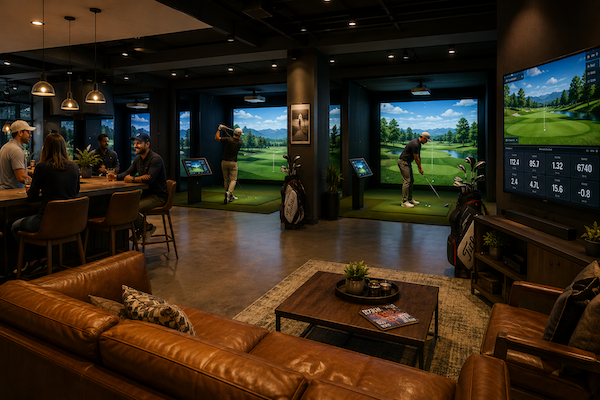
Golf lounges. Relaxed spaces to play, eat, drink, and socialize. Lower-key, higher food and beverage spend.
Private golf suites. Smaller, premium setups for private bookings, groups, and private events.
Training-focused facilities. Built for competitive golfers who want swing data and coaching on top-tier launch monitors.
Entertainment venues. Fun-first, game-heavy rooms that welcome beginners and non-golfers.
Sports bars with simulators. Indoor golf plus food, drinks, and screens. Sports bars like these trade a bigger buildout for more ways to earn per visit.
Most successful operators commit to one primary model instead of trying to serve every target market at once. Whatever model you pick, an inviting atmosphere does a lot of the selling for you, because people come back to places that simply feel good to walk into.
Is a Golf Simulator Business Profitable?
Yes, but profit lives and dies on utilization. Full bays make money. Empty bays burn it.
Here is what the numbers look like when it works. Industry estimates suggest a well-run 6-bay facility can generate $500,000 to $900,000 annually, with profit margins commonly landing in the 15 to 25 percent range after expenses. Many operators reach break-even within 12 to 18 months, assuming bookings ramp the way the plan expects.
That said, hardware is both the largest cost and the largest revenue segment in the market (Grand View Research puts it at 59.4%), so it is tempting to think the equipment is the business. It is not. The equipment is the price of entry. What you do with it, how full you keep it, and how well you retain customers is what decides whether you generate revenue or just generate invoices. Track the key metrics that actually predict profit, mainly bay utilization, average revenue per booking, and membership retention, and revisit those key metrics every month.
Golf Simulator Business Startup Costs
The initial investment is the steepest hill. For a real commercial venue, startup costs typically range from $150,000 to $500,000, depending on the number of bays, your lease, your buildout, and how premium you go on equipment. A single budget bay can come in far lower, but a multi-bay commercial space lands in that range.
Securing funding is crucial, and most owners use a mix of savings, an SBA loan, or investors. Here is where the money goes:
Equipment, per bay. A commercial bay (launch monitor, screen, enclosure, projector, mat, computer) runs $10,000 to $25,000 and up. See our full breakdown of how much a golf simulator costs.
Lease and buildout. Rent, construction, electrical, and turning a raw commercial space into bays. Often as big as the equipment line.
Design and installation. Most operators underestimate this line. Turning a shell space into a working multi-bay venue means space planning, structural clearance, electrical loads, projector geometry, and enclosure fitment, and getting any of those wrong is expensive to correct after drywall goes up. Some operators self-manage the build with a general contractor, while others hire a firm that handles design and install as one engagement. Across the nation, Pioneer Golf does space planning, 3D renderings, equipment sourcing, and installation together, which removes the coordination burden from the owner.
Furniture, finishes, and tech. Seating, lounge or bar areas, and your booking and point-of-sale software.
Operating expenses. Staff, utilities, insurance, equipment maintenance, and marketing once the doors open.
Pricing that line means pricing real components, not a range you read online. Enclosure, impact screen, and projector are the pieces first-time operators underestimate most, because commercial-grade versions cost more and outlast the DIY equivalents that dominate search results. Carl's Place publishes open pricing on commercial enclosures and impact screens, which makes it a useful reference point when you stress-test your equipment budget against a real quote rather than an average.
One way to protect margins from day one is a 24/7 access model. Letting members book and enter with a keypad or app outside staffed hours can reduce operational costs in a golf simulator business while squeezing more revenue out of the same bays.
Location and Space Requirements
The right location does more for a golf simulator business than almost any other early decision. Foot traffic, visibility, parking, and rent all feed the bottom line, so the right location deserves careful consideration before you sign anything.
Space requirements come next. A minimum room size for a golf simulator is about 10 to 12 feet wide, with enough depth and ceiling height for a full swing. One bay needs that footprint, and a multi-bay venue needs it repeated, plus room for seating and circulation. Map your space requirements against the number of bays you want before you commit to a commercial space, because cramming in one bay too many makes the room feel tight to every customer who walks in.
The Simulator Technology That Actually Matters
Your simulator technology is what customers judge you on, so do not cut corners on the part they can feel. Accurate data for training is now a baseline customer expectation in golf simulators, not a premium feature, and high-quality technology is critical for customer retention. A laggy screen or shaky readings is how a first-timer becomes a never-again.
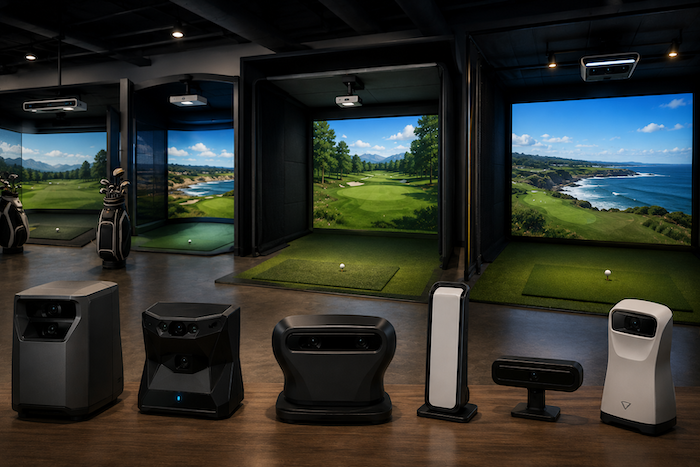
The launch monitor is the heart of it. Launch monitors track ball speed, launch angle, and spin rate, and the better ones read all of it with the accuracy serious golfers notice. The brands split roughly by purpose. TrackMan and aboutGOLF prioritize accuracy for serious golfers and training, while Golfzon and Full Swing focus on entertainment features built for social venues. Choosing the best golf simulator for your venue comes down to which of those two crowds you are building for.
One piece people forget is ongoing support and maintenance. Simulator technology needs updates, calibration, and regular equipment maintenance to keep delivering accurate ball data, so budget for it. Good software earns its keep here too. A deep library of game modes (closest-to-the-pin, scrambles, long-drive contests) turns a flat practice session into a night out, and a polished immersive environment keeps groups laughing and rebooking. Still, resist the urge to over-amenity the place before the golf is great. Prioritizing simulation quality over extra amenities leads to better customer satisfaction and an immersive golf experience that keeps people coming back, every time.
Revenue Streams for an Indoor Golf Business
A strong indoor golf business never relies on one income line. Spreading your revenue streams is what carries you through slow Tuesdays and maxes out busy Saturdays.
Bay rentals. Hourly bookings, your fastest cash. Peak and off-peak pricing keeps weekdays moving.
Memberships. Recurring monthly or annual revenue and the backbone of a loyal customer base. Perks like priority booking and discounted bay time keep members renewing.
Lessons and coaching. High-margin, and they drive repeat business. On-staff golf pros turn beginners into regulars.
Leagues, tournaments, and corporate events. Big-ticket bookings that fill multiple bays at once, and a natural fit for team building outings. Hosting events and private events on slow weekdays is some of the easiest money you will make.
Food and drinks. Even a small menu lifts per-head spend and keeps people in their seats longer.
The healthiest venues lean on memberships for steady revenue, bay rentals and corporate events for the upside, and lessons and food as high-margin add-ons. Additional services like club rentals, club fitting, and a small pro shop layer on extra margin without much added overhead.
Pricing Strategy and Keeping Bays Full
Your pricing strategy does more than set a number. It shapes who books and when. Tiered pricing, lower during off peak hours midweek and premium on Friday and Saturday nights, smooths demand and protects your best slots. Filling those off peak hours with leagues and lessons is where a lot of quiet profit hides. League and event pricing fills the dead hours. Membership pricing locks in recurring revenue.
The other half of a full calendar is retention. It costs far more to win a new customer than to keep one, so build the model to retain customers, not just acquire them. Reward repeat business, make satisfied customers feel like regulars, and incentivize customers to come back with loyalty perks, member-only nights, and small touches that turn a one-time visit into a habit.
Marketing Your Golf Simulator Business
You can have the best bays in town and still sit empty if nobody knows you exist. Start with a strong brand identity: a name, look, and voice that resonate with your audience and make the venue feel like a place worth visiting. A simple digital marketing plan covers the rest: a clean website with online reservations, a Google Business Profile so local customers find you, and active social accounts showing real people having fun.
Content marketing is underrated here. Sharing golf tips, swing breakdowns, and local league recaps positions your business as a thought leader and pulls in search traffic at the same time. A quick market analysis of who is already nearby tells you which target demographic to chase first. Different customer segments respond to different messages, so speak to serious golfers and casual night-out crowds in their own language. And nothing markets a venue like positive reviews and a simple referral program that turns happy regulars into a sales team you do not pay.
How to Write a Golf Simulator Business Plan
A real business plan is what separates an operator from a hobbyist. Four pieces matter most.
1. Define your target audience and business goals. Serious golfers, players who just want some casual play, non-golfers, corporate groups: pick your target market and your business goals before you design the space. Understanding market needs is essential when starting a golf simulator business, and it starts with a deep understanding of exactly who you serve and what their customer needs really are.
2. Do thorough market research. Study local competitors, their pricing, and their gaps. Thorough market research helps you find an angle instead of opening as the fifth identical lounge in town.
3. Choose your business model. Memberships, hourly play, franchise, lounge, or a hybrid. Each business model carries different costs and margins, so match the business model to your space and audience.
4. Plan operations, compliance, and projections. Map staff, maintenance, and operating expenses against honest booking projections. Understanding local regulations is essential for compliance, from alcohol licensing to occupancy limits, so handle it before you open, not after.
A comprehensive business plan is the difference between a business that scales and one that stalls, so it is worth the time for any new business owner.
Where Booking Software Fits
Once bookings ramp, manual scheduling becomes the bottleneck. Double-bookings, missed memberships, and no-shows quietly drain a golf simulator business. Sports Carnival's booking software for golf simulators brings bookings, online reservations, memberships, payments, waivers, and scheduling into one system, so your staff runs the floor instead of fighting a calendar, and your bays stay as full as demand allows.
Final Thoughts
A golf simulator business is a real opportunity, not a guaranteed one. A golf simulator business rewards operators, not gamblers, and the best golf simulator operators treat every empty bay as money left on the table. The market is growing, the customers are there, and the model works when you treat it like a business: a clear plan, strong simulator technology, multiple revenue streams, a sharp pricing strategy, and operations that keep your bays full and your customers coming back.
Get those right and you are not just running an indoor golf facility. You are building a business people in your town actually want to keep visiting. For the equipment side of the decision, start with our guide on how much a golf simulator costs.
FAQs
How much does it cost to start a golf simulator business? For a commercial multi-bay venue, startup costs typically range from $150,000 to $500,000, depending on the number of bays, equipment, location, and buildout. Commercial bays run about $10,000 to $25,000 and up each before lease, construction, and software.
Is a golf simulator business profitable? Yes. A well-run 6-bay facility can generate roughly $500,000 to $900,000 in annual revenue, with profit margins commonly in the 15 to 25 percent range after expenses, and many venues reach break-even within 12 to 18 months. Profitability depends on keeping bays booked.
How much space do golf simulator bays need? A commercial bay generally needs about 12 feet of width, 15 feet of depth, and 9 to 10 feet of ceiling height for a comfortable full swing. A little extra room improves the experience and your equipment options.
What is the best launch monitor for commercial use? TrackMan, Foresight Sports, Uneekor, and Full Swing are popular commercial launch monitors. TrackMan and aboutGOLF are known for accuracy that serious golfers trust, while Golfzon and Full Swing offer entertainment features suited to social venues.
Can a golf simulator business work in a smaller city? Yes. Smaller cities often have less competition and strong demand for year-round indoor entertainment, which makes a golf simulator business a strong draw for local customers and families.
Continue Reading
Articles you might be interested in